

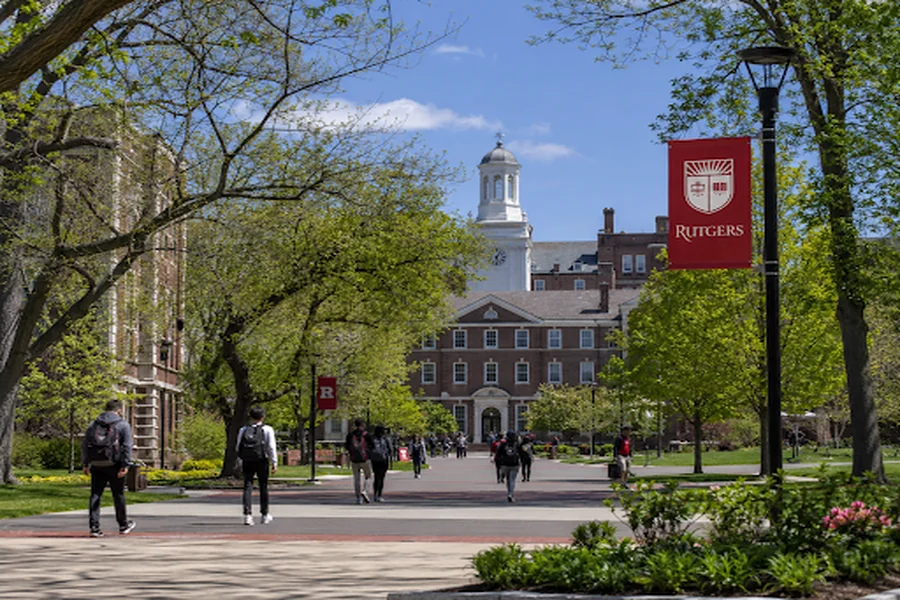
When students search for the Rutgers University acceptance rate, they often land on a single number-somewhere around 65–79% and assume that applies everywhere. It doesn’t. Rutgers operates three distinct campuses, each with its own admissions culture, academic programs, and level of selectivity. Treating them as interchangeable is one of the most common mistakes applicants make.
This guide breaks down the real numbers by campus, explains what those numbers actually mean for your application, and gives you the program-level context that generic admissions articles leave out.
The Problem With the “One Number” Approach
If you Google “Rutgers University acceptance rate,” you will see figures ranging from 58% to 79% depending on the source and the year. Both can be accurate, they are just measuring different things.
The 79% figure comes directly from Rutgers’ official admissions FAQ, which reports the aggregate acceptance rate across all three campuses combined for full-time, degree-seeking applicants. The more competitive figures reflect New Brunswick specifically, where application volume has surged dramatically since Rutgers joined the Common App, pushing the 2024–25 cycle to over 240,000 applicants system-wide.
What this means for you: Quoting the system-wide number when you’re applying to the School of Engineering or Rutgers Business School at New Brunswick is like using the average score of three different tests to predict your result on the hardest one. The numbers below give you a more accurate picture.
Rutgers–New Brunswick: The Flagship, and the Most Selective
Overall acceptance rate: approximately 58–67% Competitive programs (Engineering, Business, Pharmacy): as low as 35–40%
New Brunswick is the original Rutgers campus, founded in 1766, and its level of competition reflects its flagship status. The campus is home to some of the university’s most sought-after programs, including:
- Rutgers Business School (RBS): One of the top business programs among public universities in the Northeast, with concentrations in finance, accounting, supply chain, and more.
- School of Engineering (SOE): Nationally recognized programs in electrical and computer engineering, biomedical engineering, and chemical engineering. Admission to SOE is significantly more competitive than the campus-wide rate.
- Ernest Mario School of Pharmacy (EMSOP): A six-year PharmD track that is among the most selective entry points at Rutgers. Applicants typically need top-quartile GPAs and test scores.
- School of Arts and Sciences (SAS): The largest school on campus, offering over 100 majors across humanities, social sciences, STEM, and pre-professional tracks.
- School of Nursing (SON): Highly competitive nursing program that admits students directly from high school into clinical pathways.
- Mason Gross School of the Arts (MGSA): One of the country’s few comprehensive public performing arts schools, offering programs in music, theater, dance, and visual arts.
Academic profile of admitted students (middle 50%):
- GPA: 3.7–4.1 (weighted)
- SAT: 1270–1480
- ACT: 28–33
- Median SAT: 1,410 | Median ACT: 31
What these numbers mean: The median SAT of 1,410 puts admitted students in roughly the top 15% of all test-takers nationally. But because Rutgers is test-optional through the 2025–26 cycle, 49% of enrolled students did not submit scores at all. This means your GPA and course rigor carry especially significant weight. Rutgers explicitly identifies high school course rigor and GPA as the two “very important” factors in its admissions review.
In-state vs. out-of-state: For the Class of 2027, in-state applicants were admitted at a 62% rate while out-of-state applicants were admitted at 72%. This counter-intuitive gap reflects the competitive New Jersey applicant pool New Brunswick attracts the state’s highest-achieving students, making in-state admission more contested.
Signature financial aid program: The Scarlet Guarantee covers full tuition for eligible New Jersey students whose family income falls below a certain threshold, making this nationally competitive school accessible to students across the economic spectrum.
Rutgers–Newark: Urban Focus, Broader Access With Pockets of Selectivity
Overall acceptance rate: approximately 72–74% Selective programs (Nursing): significantly more competitive
Rutgers–Newark is often underestimated because its headline acceptance rate suggests it is easy to get into. The reality is more nuanced. The campus has built a distinctive identity around urban engagement, career-focused pathways, and a deeply diverse student body, it has been ranked among the most diverse universities in the United States.
Programs worth knowing about:
- Rutgers Business School–Newark and New Brunswick: Newark students have access to the same accredited business programs as New Brunswick, including accounting, finance, and management.
- School of Nursing–Newark: Direct-entry nursing is competitive system-wide, and Newark’s program is no exception.
- School of Criminal Justice: One of the most highly regarded criminal justice programs in the country, with strong ties to law enforcement, policy organizations, and the legal profession in the New York–New Jersey metro area.
- College of Arts and Sciences–Newark: Offers strong pre-law and pre-health tracks, supported by proximity to major hospitals and legal institutions in the region.
Academic profile of admitted students:
- GPA: 3.4–4.0 (estimated range for admitted students)
- SAT: 1020–1200 (middle 50% range)
- ACT: 19–25 (middle 50% range)
What these numbers mean: The broader GPA and test score range reflects Newark’s commitment to access and holistic review. A student with a 3.2 GPA but strong leadership, community involvement, and a compelling personal statement is a real candidate here. The campus particularly values applicants who demonstrate awareness of and connection to urban communities and real-world professional goals.
Signature financial aid program: RU-N to the TOP is Newark’s last-dollar scholarship program designed to close the gap after federal and state aid for eligible New Jersey students, making a Rutgers degree attainable for students who might otherwise be priced out.
Rutgers–Camden: The Most Accessible Campus and More Than a Safety School
Overall acceptance rate: approximately 76–79% Average GPA of admitted students: 3.2–3.8
Camden is the smallest of the three campuses and carries the highest acceptance rate. But reducing it to a “backup option” misses what it actually offers: a genuinely intimate university experience backed by the full Rutgers name, research infrastructure, and alumni network.
Programs of note:
- Rutgers School of Business–Camden: AACSB-accredited, with strong undergraduate programs in accounting, business analytics, and management. Small class sizes mean more direct faculty access than you would find at a larger campus.
- Rutgers School of Nursing–Camden: Offers BSN programs with clinical placements in a region that includes Cooper University Hospital, one of South Jersey’s major academic medical centers.
- Camden College of Arts and Sciences: Strong pre-law track, with connections to nearby law firms and the federal court system in the Delaware Valley.
- Honors College at Camden: Offers a selective, seminar-based experience for high-achieving students who want small class sizes and undergraduate research opportunities within a more accessible admissions environment.
Academic profile of admitted students:
- GPA: 3.2–3.8 (estimated range; no official minimum GPA required for transfer applicants)
- SAT: 980–1170 (middle 50% range)
- ACT: 18–22 (middle 50% range)
What these numbers mean: Camden’s higher acceptance rate reflects its smaller applicant pool and its mission to serve South Jersey students. But the graduation rate across all three campuses is 80%, and Camden’s students participate in the same Rutgers research ecosystems and alumni networks as their counterparts in New Brunswick and Newark. For students who want personalized attention and a less overwhelming campus experience, Camden can be the right fit rather than the fallback.
Signature financial aid program: Bridging the Gap is Camden’s last-dollar aid program for eligible New Jersey residents, following the same model as the Scarlet Guarantee and RU-N to the TOP.
Side-by-Side Comparison
| Factor | New Brunswick | Newark | Camden |
| Overall Acceptance Rate | ~58–67% | ~72–74% | ~76–79% |
| Competitive Program Rate | 35–40% (Engineering, Pharmacy) | Higher for Nursing | Higher for Nursing |
| Middle 50% GPA | 3.7–4.1 | 3.4–4.0 | 3.2–3.8 |
| Middle 50% SAT | 1270–1480 | 1020–1200 | 980–1170 |
| Middle 50% ACT | 28–33 | 19–25 | 18–22 |
| Campus Size | ~50,000 students | ~14,000 students | ~8,000 students |
| Signature Aid Program | Scarlet Guarantee | RU-N to the TOP | Bridging the Gap |
What Rutgers Looks at Beyond the Numbers
All three campuses conduct holistic review. According to Rutgers’ official admissions process documentation, the two factors considered “very important” are:
- Rigor of high school coursework – AP, IB, dual enrollment, and honors courses signal that a student has challenged themselves academically.
- GPA – Rutgers recalculates GPAs with a focus on core academic subjects rather than electives.
Other factors that matter, though weighted less heavily:
- Personal statement / Common App essay (no supplemental essays required except for the Honors College)
- Extracurricular activities
- Work experience and community involvement
- Self-Reported Academic Record (SRAR) required for current high school seniors
Rutgers does not consider demonstrated interest, meaning campus visits and emails to admissions officers have no bearing on your application.
Application Deadlines (All Three Campuses)
- Early Action: November 1 (decision by January 31)
- Regular Decision: December 1
- Spring Transfer: October 1
- Fall Transfer: February 1
Applying early action is strongly advisable. Beyond the earlier decision timeline, applying in November gives you more time to weigh financial aid offers before the national May 1 commitment deadline.
Rutgers University Requirements: What You Need to Apply
Rutgers has three main campuses: New Brunswick, Newark, and Camden, each with slightly different admissions requirements. All first-year applicants submit the Rutgers Application or Common App, pay the $70 fee (or get a waiver), and provide high school records. Current seniors must complete the Self-Reported Academic Record (STARS).
GPA: No official minimum. Competitive admits at New Brunswick usually have 3.7+ weighted GPA; Newark and Camden are more flexible (3.2+).
High School Courses: Most programs expect 16 academic courses, including English, math, and science. Some schools (Engineering, Nursing, Pharmacy, Mason Gross Arts) require specific coursework or auditions/portfolios.
Test Policy: Test-optional for New Brunswick and Camden; test-blind for most Newark programs. Students may submit SAT/ACT if it strengthens their application.
Essays: A short original essay is required. Honors College applicants at New Brunswick must complete an additional honors question.
Financial Aid: Complete the FAFSA using Rutgers federal code 002629. CSS Profile is not generally required.
Checklist: Application form, fee/waiver, STARS, essay, optional test scores, English proficiency (if needed), FAFSA, and any program-specific materials (portfolio, audition, prerequisites).
Check your specific campus and program for exact requirements—admissions are holistic, but strong grades, rigorous coursework, and complete applications improve your chances.
What the Rankings Mean in Context
Rutgers–New Brunswick is consistently ranked among the top 25 public universities in the United States by multiple outlets, including U.S. News & World Report. The university system as a whole is classified as an R1 doctoral research institution, the highest Carnegie classification, meaning students at all three campuses have access to faculty doing nationally significant research.
Rutgers university ranking figures vary by source and methodology, but the flagship’s position among the top public universities is stable, with particular strength recognized in pharmacy, engineering, public policy, business, and the life sciences.
For prospective students, these rankings matter most as a signal that a Rutgers degree carries weight with employers and graduate programs. The university’s location in the New York–New Jersey metropolitan corridor, one of the most job-dense regions in the country, also directly benefits students through internship pipelines, clinical placements, and early career recruitment.
Final Takeaway: Choose the Campus That Fits Your Profile and Goals
The Rutgers university admissions rate is not one number, it is a range of experiences depending on which campus you are targeting and which program you are applying to. Here is a simplified decision framework:
- Targeting New Brunswick? Aim for a 3.7+ weighted GPA. If applying to Engineering, Business, or Pharmacy, treat this more like a selective school application and sharpen your essay accordingly.
- Targeting Newark? A 3.2–3.5 GPA puts you in range. Emphasize your goals, career focus, and any connection to urban or professional environments.
- Targeting Camden? A 3.2 GPA is competitive. Focus on why Camden’s smaller environment fits your learning style, and consider the Honors College if your profile is strong.
