
For most of the past decade, AI governance meant managing models. A team trained a model, validated it once before launch, watched a few accuracy dashboards, and moved on. That approach is now badly out of step with how enterprises actually deploy AI. The systems reaching production in 2026 increasingly are not static models at all but autonomous agents that take actions, hold memory, call tools, and operate semi-autonomously across long-running sessions.
This shift matters because agents do not fail the way models do. A model returns a bad prediction; an agent can take a bad action, then chain it into several more before anyone notices. The governance practices built for point-in-time model validation simply cannot see these failure modes, let alone prevent them. At the same time, the regulatory bar is rising fast, with the EU AI Act’s high-risk obligations becoming enforceable in August 2026 and standards such as ISO/IEC 42001 moving into procurement requirements.
This guide is a practical reference for enterprise teams navigating that environment. It covers what AI governance now has to mean, the 2026 regulatory landscape, why autonomous agents demand a different operations layer, and a phased roadmap for building a program that produces continuous, audit-ready evidence rather than a policy document that sits on a shelf.
What AI Governance Really Means Now
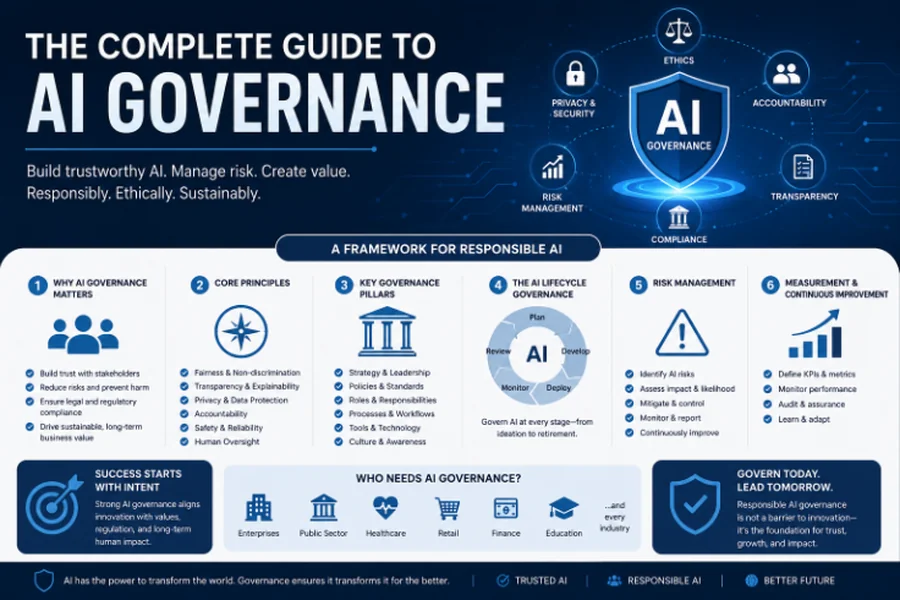
AI governance is the operating framework that determines how AI systems are approved, deployed, monitored, and retired inside an organization. It is the combination of policies, technical controls, and oversight mechanisms that together produce continuous, audit-ready evidence across the full lifecycle, from the moment a use case is proposed through production monitoring and incident response.
It helps to be clear about what governance is not. A policy document is not governance. Many programs fail precisely because they confuse the two: they write an acceptable-use policy, circulate it, and assume the work is done. Real governance lives where the AI actually runs, in the data pipelines, the tool calls, the agent traces, enforcing rules automatically rather than relying on goodwill. The most durable programs treat governance as part of the platform itself, not a separate review step bolted on afterward.
The Core Objectives
- Accountability: every AI system has a named owner responsible for its behavior and authorized to pause or roll it back.
- Transparency: stakeholders can understand what a system does, what data it touched, and when they are interacting with AI.
- Fairness: bias is tested for and mitigated throughout the lifecycle rather than discovered after harm occurs.
- Compliance: the organization can demonstrate, with evidence, that it meets the regulations and standards that apply to it.
- Reliability and security: systems are robust, observable, and protected against misuse, data leakage, and adversarial manipulation.
The 2026 Regulatory Landscape
Three reference points dominate enterprise conversations in 2026: the EU AI Act, the NIST AI Risk Management Framework, and ISO/IEC 42001. They are different kinds of instrument and serve different purposes, so it is worth understanding each before deciding how they fit together. For organizations operating in India, the DPDP framework and emerging RBI guidance on AI add a further layer.
The EU AI Act
The EU AI Act is a law, not a voluntary standard, and it has extraterritorial reach: it can apply to organizations outside the European Union whose AI systems affect people inside it. It classifies systems into four risk tiers, and obligations scale with risk. Practices such as social scoring fall into an unacceptable-risk tier and are banned outright. High-risk systems, used in areas such as biometric identification, critical infrastructure, education, employment and recruitment, essential services, law enforcement, and the administration of justice, face the strictest requirements. Limited-risk systems such as chatbots carry transparency obligations, and minimal-risk uses face no specific restrictions.
The timeline matters more than anything else this year. Prohibited-use bans and AI-literacy obligations applied from February 2025, and general-purpose AI model rules entered into force in August 2025. The pivotal date for most enterprises is 2 August 2026, when obligations for high-risk systems become fully enforceable; obligations for AI embedded in other regulated products follow in August 2027. High-risk obligations include risk assessment, data governance, activity logging for traceability, detailed technical documentation, human oversight, and post-market monitoring.
Penalties are significant. Non-compliance with high-risk requirements can reach up to EUR 15 million or 3 percent of worldwide annual turnover, whichever is higher, while supplying incorrect or misleading information to authorities can reach up to EUR 7.5 million or 1 percent of turnover. The most severe breaches, involving prohibited practices, carry the highest ceilings.
NIST AI RMF and ISO/IEC 42001
The NIST AI Risk Management Framework is a voluntary structure organized around four functions, Govern, Map, Measure, and Manage, that move from establishing a culture of risk management to assessing, tracking, and acting on risks. It has no certification, but alignment strengthens proposals in procurement where buyers increasingly evaluate governance maturity. ISO/IEC 42001, published in 2023, is the first international standard for an AI management system and, unlike the others, is certifiable through accredited bodies. It does not automatically satisfy the EU AI Act, but it builds much of the infrastructure the Act requires and maps cleanly onto all four NIST functions, so evidence gathered for one tends to satisfy the others.
How the Three Fit Together
| Dimension | EU AI Act | NIST AI RMF | ISO/IEC 42001 |
|---|---|---|---|
| Type | Binding law | Voluntary framework | Certifiable standard |
| Primary value | Legal compliance, market access | Risk structure, procurement | Auditable management system |
| Certification | Conformity assessment for high-risk | None | Third-party, two-stage audit |
| Key 2026 signal | 2 Aug 2026 high-risk enforcement | Ongoing reference | Increasingly required in RFPs |
For resource-constrained teams, a common path is to build to ISO/IEC 42001 as the certifiable core, use the NIST crosswalk to cover overlapping expectations, and extend the same system to meet the EU AI Act obligations that apply. Cross-framework mapping can meaningfully reduce duplicate effort.
The Hard Part: Governing Autonomous Agents
Frameworks tell you what to achieve. They were not, however, written for autonomous agents, and that is where most 2026 governance programs run into trouble. An agent learns, adapts, and acts across distributed environments, often beyond direct human oversight. It introduces failure modes that traditional model monitoring was never designed to detect.
- Confused-deputy data exfiltration: an agent with privileged access is tricked into leaking sensitive data through its own legitimate tools.
- Indirect prompt injection at scale: hidden instructions buried in routine emails, web pages, and documents hijack agent behavior without the user ever being aware.
- Memory and RAG corruption: knowledge bases poisoned with fabricated content that the agent then treats as verified fact.
- Tool misuse and unauthorized actions: an agent executes high-privilege actions triggered by externally sourced content rather than genuine user intent.
- Behavioural drift across sessions: an agent’s decision patterns shift silently as its memory accumulates manipulated content.
The common thread is that none of these failures shows up in a single pre-launch test. They emerge at runtime, from the interaction between an agent, its tools, its memory, and the untrusted content it encounters. Point-in-time validation and human-reviewed dashboards simply cannot keep pace with systems that act autonomously around the clock. This is the core insight behind agent-native assurance platforms such as Trusys, which treat governance as a continuous operating loop rather than a gate the system passes through once.
From Point-in-Time Testing to Continuous Assurance
The practical answer is to extend governance across the whole agent lifecycle and to automate it. In broad strokes, that means four capabilities working together: adversarial testing that probes agents the way attackers actually attack them, behavioural evaluation that scores how agents reason and use tools rather than just how they answer prompts, runtime observability that traces every action with full lineage, and inline guardrails that enforce policy at the input, output, and action layers without modifying the agent itself.
Trusys organizes these as four products, TruScout for adversarial testing mapped to taxonomies like the OWASP Agentic AI Top 10 and MITRE ATLAS, TruEval for behavioural evaluation across tool use and memory persistence, TruPulse for runtime observability with full action lineage, and TruGuard for inline policy enforcement, with an autonomous governance agent, Argus, running them continuously and surfacing only what needs human judgement. The detail of any one vendor matters less than the principle: in an agentic world, assurance has to run at the speed the agents themselves run.
A Phased Roadmap to Build Your Program
Governance succeeds when it is rolled out in deliberate phases rather than launched as a single large initiative. The following five phases give enterprise teams a realistic sequence that holds up for both models and agents.
Phase 1: Inventory and Classify
You cannot govern what you cannot see. Build an inventory of every AI system in use, including shadow deployments, embedded vendor features, and every agent your teams have shipped. For each one, record its purpose, the data and tools it can access, and whether you are acting as a provider, a deployer, or both. Then classify each against the relevant risk tiers so you know where to concentrate effort. For agents, this inventory must also capture tool permissions, memory stores, and egress paths, since those define the real attack surface.
Phase 2: Assign Accountability
Every high-risk system needs a named accountable owner before the August 2026 deadline. A cross-functional governance council should bring together AI engineering, data science, legal, compliance, security, and the business so decisions are both technically valid and aligned with business needs. Crucially, define stop authority: the formally assigned right of a named individual to pause, halt, or roll back a system in production without waiting for escalation.
Phase 3: Embed Governance Checkpoints
Integrate review gates across the lifecycle, at data collection, design, deployment, and monitoring, so bias, compliance gaps, and security weaknesses are caught early. Document systems, track data lineage, test for bias, run adversarial testing against agents before launch, and define escalation paths. This documentation also underpins regulatory defenses and conformity assessments.
Phase 4: Operationalize in the Platform
The most effective programs implement governance as part of the AI platform rather than as a separate oversight layer. This lets the organization enforce policy automatically, address the common problem of fragmented and uncontrolled AI access, and still let teams move quickly. For agents specifically, this is where inline guardrails and continuous runtime tracing replace periodic manual review.
Phase 5: Monitor, Report, and Improve
Once systems are in production, continuous monitoring closes the loop: trace agent actions, watch for behavioural drift and policy violations, run post-market monitoring, and feed incidents back into the risk process. Automatically generated, audit-ready evidence keeps you prepared for regulators and procurement reviews without a frantic scramble before each one.
Best Practices That Separate Mature Programs
- Treat governance as a competitive advantage, not a compliance burden. Teams that do tend to scale AI more sustainably and adopt advanced capabilities faster.
- Align governance with the risk, security, and IT frameworks you already run, so it scales rather than becoming a parallel bureaucracy.
- Govern the whole estate, not one model at a time. Apply consistent policy across every agent, framework, and platform.
- Assume runtime risk. For agents, the dangerous failures appear in production, so continuous observability matters more than any single pre-launch test.
- Make ownership unambiguous. Named owners and explicit stop authority prevent the diffusion of responsibility that lets incidents linger.
- Automate evidence collection. Continuously generated audit-ready documentation beats a scramble before every audit or RFP.
Conclusion
AI governance in 2026 is no longer a forward-looking nice-to-have. With high-risk obligations under the EU AI Act becoming enforceable in August, ISO/IEC 42001 entering procurement requirements, and autonomous agents introducing entirely new runtime risks, enterprise teams need programs that produce real, continuous evidence of responsible AI, not a policy document gathering dust.
The path forward is clear: inventory and classify your systems, assign accountable owners, embed checkpoints across the lifecycle, operationalize governance in your platform, and monitor continuously. The organizations that start now will not only avoid penalties but also earn the trust that lets them deploy AI, and especially agents, more ambitiously than competitors who treat governance as an afterthought. In an agentic world, trust is no longer optional; it is a competitive advantage.
About Trusys. Trusys is an enterprise AI assurance and governance platform built ground-up for autonomous agents. It combines adversarial testing, behavioural evaluation, runtime observability, and inline guardrails, orchestrated by an autonomous governance agent, to deliver continuous, audit-ready assurance across the full AI lifecycle. Learn more at trusys.ai.
This guide is provided for general informational purposes and reflects publicly reported regulatory timelines as of May 2026. Compliance deadlines and requirements can change; it is not legal advice. Organizations should consult qualified legal and compliance professionals for guidance specific to their circumstances.
